Georgia Flu pandemic
Station ElevenThe Georgia Flu pandemic is the catastrophe that divides the novel’s world into a connected pre-pandemic society and the devastated communities that follow. Its speed is central to its force: people can become critically ill within hours of exposure, leaving hospitals and public authorities little time to respond. The outbreak spreads beyond the first identified passengers, crosses borders, and ultimately helps bring about The Collapse, after which the small number of survivors struggle to find safety and build new forms of communal life.
First Cases and Rapid Spread
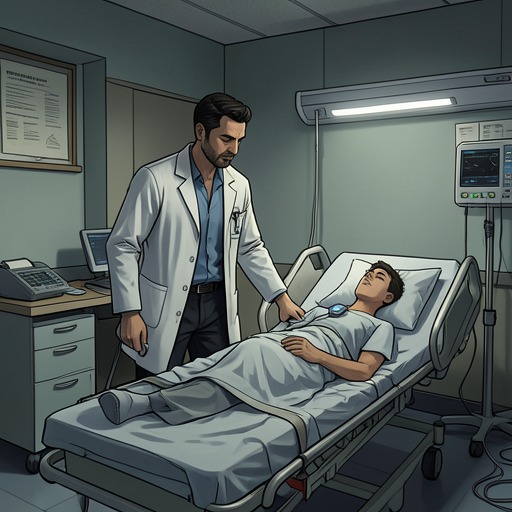
The first cases described in Toronto are linked to passengers who flew in from Moscow. Hua tells Jeevan Chaudhary that a sixteen-year-old girl has been admitted to intensive care after arriving the previous night, and that twelve more people with the same symptoms have appeared by midmorning. They had all been on the same flight and had begun to feel sick while still aboard. The initial cluster therefore arrives as both a medical emergency and an international transmission event: the passengers are already ill when they reach the city.
The link to the flight does not hold for long as an explanation of the outbreak’s boundaries. That afternoon, a hospital employee who had not been aboard the plane develops the same symptoms. Hua later describes an orderly who was working when the first patients came in, went home sick a few hours into her shift, and returned to the hospital on a ventilator. Exposure is followed by illness within hours, and the infection is already circulating among people who had not traveled with the Moscow passengers. Hua recognizes that it is spreading outside the hospital and through the city, not merely passing among one arriving group.
The speed of the crisis is reflected in the changing figures Hua gives Jeevan. By the time they speak again, more than two hundred flu patients have been admitted since morning, including 160 in the previous three hours; fifteen have died. The emergency department is full, and beds have been placed in the hallways. A patient can move from apparent exposure to severe respiratory distress on a timescale that defeats ordinary hospital capacity. The figures make the outbreak legible not as a slow rise in cases but as a surge that has already outrun the institution attempting to treat it.
Public Warnings and Failed Containment
News coverage soon confirms that the emergency is larger than the hospital. A television report seen by Jeevan states that Toronto General Hospital and two other local hospitals have been placed under isolation, and that Health Canada is confirming an outbreak of the Georgia Flu. Officials withhold case numbers while acknowledging fatalities. The report also suggests that Georgian and Russian officials may not have been transparent about the seriousness of the crisis there. Its request that the public remain calm sits uneasily beside the images of hospitals already under isolation and the news of deaths.
Hua’s warning is more urgent than the official broadcast. He tells Jeevan to leave if he can and, if he cannot, to stock up on food and stay in his apartment. Jeevan trusts the warning because Hua is given to understatement; he understands the call as evidence that the illness will mark a dividing line between life before and life after. That response turns information into action: Jeevan goes to his brother Frank’s home with shopping carts, and the two men try to protect themselves by sealing air ducts, covering windows, and blocking the door with a dresser. Their precautions register both the attempt to make a private refuge and the limits of what they can know about transmission.
The outbreak reaches people in transit as well as those already in cities. Clark Thompson, on a flight when the pandemic’s arrival in North America becomes news, sees reports of late evacuations, riots outside hospitals on three continents, and roads clogged by people trying to leave. He had heard only a brief report about a mysterious virus in Paris the day before; the scale of the emergency becomes apparent to him while he is already in the air. At Severn City Airport, the screen still announces the arrival of Air Gradia Flight 452 when an agent’s radio brings word of quarantine. Clark and roughly a hundred other passengers remain in the terminal, while some people who try to leave return after discovering there is no ground transportation.
The Speed of Death and the Breakdown of Information
The disease’s incubation and fatal course give the pandemic a tempo that renders distance and delay dangerously deceptive. An epidemiologist explains that exposure can be followed by symptoms in three or four hours, with death in a day or two. The symptoms include aches, a sudden high fever, and difficulty breathing. The hospital cases, the Moscow flight, and the stranded passengers at Severn City Airport together show how quickly a local cluster can become a crisis of movement, care, and containment. The narrative offers no reliable interval in which ordinary systems can catch up.
The failure of those systems becomes visible in the news itself. During the first days of the crisis, Jeevan and Frank watch broadcasts that grow increasingly improvised as professional newscasters disappear from the screens. Reports from Moscow stop, followed by reports from Beijing, Sydney, London, Paris, and other cities; social media fills with rumors. Local stations drop away until the final channel shows network employees taking turns before a camera to share whatever information they have. When the broadcasts end, the loss is more than a change in entertainment: a common channel for news, reassurance, and connection has gone dark.
The people at Severn City Airport encounter the same contraction on a smaller scale. By the third day, vending machines have been emptied, and a sick girl cannot obtain the Effexor she needs. Searches through offices, a security holding cell, desks, and abandoned cars uncover shoes and warm clothing but no solution to her medication crisis. By the eighth day, no new arrivals have come and nobody who left has returned. A former park ranger and Tyrone, the remaining TSA agent, hunt a deer; the group cooks it over a fire and drinks the last champagne. The girl leaves through another airport entrance and walks into the trees. A search party fails to find her. The detail of a meal shared amid scarcity is set beside the disappearance of someone whom the stranded community cannot save.
From Pandemic to The Collapse
The pandemic is followed by The Collapse: the shock of widespread death and the failure of the systems that had organized everyday life. Jeevan later walks for five days before seeing another person. He had feared being robbed in a lawless world, but the emptiness gradually reveals something worse: the illness has left almost no one. In the years that follow, people first travel in search of somewhere life might continue as before, then settle in truck stops, former restaurants, and old motels, clustering for safety. The Travelling Symphony begins its journeys five years after the collapse, when its conductor leaves an air base with friends from a military orchestra and sets out into the changed landscape.
The pandemic’s reach also appears in accounts of a world already strained by economic failure. Before or around the catastrophe, twelve percent of the global shipping fleet lies at anchor off the coast of Malaysia, its ships staffed by only a few people each. Later, Miranda sees a fleet of vessels off Singapore Harbour, including Neptune Logistics ships ordered during an anticipated boom and completed while the economy was imploding. These ships are not presented as a direct consequence of the virus; their stillness shows how fragile global commerce had become even before the new social order took shape. The pandemic then makes the severing of transport and communication part of a much larger rupture.
Memory, Inheritance, and Significance
The pandemic is remembered through concrete remnants as well as through statistics. A photograph of Arthur Leander carrying his small son belongs to a moment a year before the Georgia Flu arrives. In a later world, Clark’s attention to a snow globe leads him to consider the chain of human labor behind an ordinary manufactured object: its design and assembly, its shipment across an ocean, and its delivery to Severn City Airport. The globe’s miniature snowstorm distorts the planes visible inside it. What had once been one small item in a functioning supply chain becomes an occasion to imagine the people and connections that made it possible.
For people born into the aftermath, even electricity and the Internet survive first as stories and uncertain possibilities. In Traverse City, an inventor uses a stationary bicycle to power a laptop while searching for the Internet. Kirsten Raymonde is fascinated by electricity and imagines lamps, a nightlight, a chandelier, and a brilliantly lit stage; the screen itself offers only a message that the webpage is unavailable. The contrast between these remembered forms of ordinary life and the survivors’ limited access to power makes the pandemic’s consequence more than demographic loss. It changes what can be known, made, and shared, while leaving objects, images, and stories as partial evidence of the vanished world.